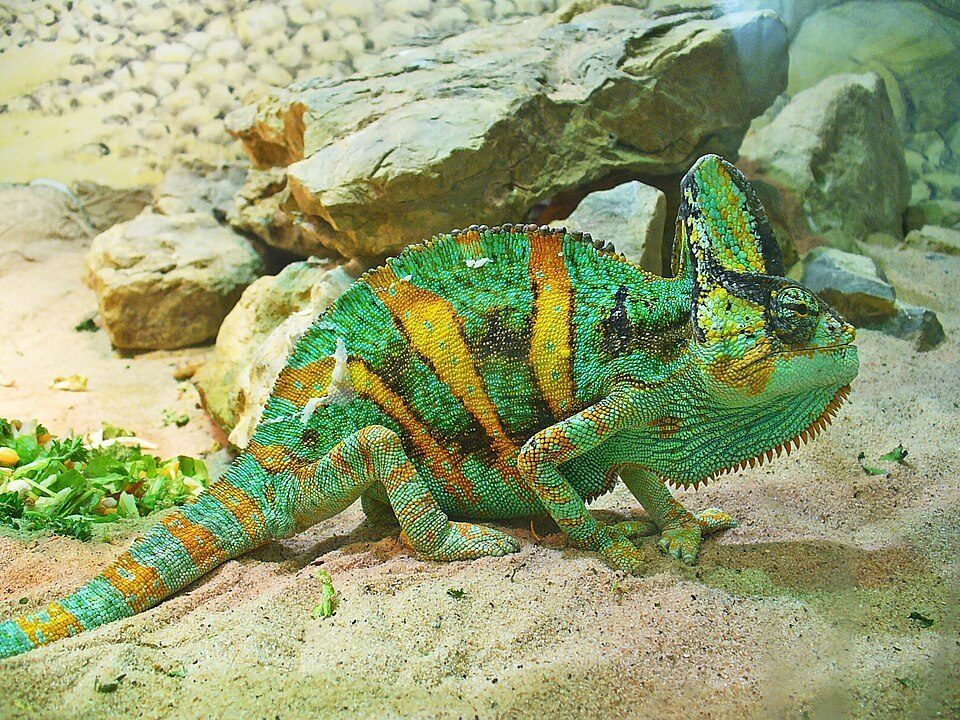
Can I keep it?
Setup
The numbers
Temperature
One ambient band, 22–27°C, dropping to 18–21°C at night. Same scale on every sheet here, so two species compare by eye.
The sheet statesbasking 29-35 °C (85-95 °F) / ambient 22-27 °C / night 18-21 °C
Humidity
The sheet states40-50% day, 80-100% night (mist)
UVB
The sheet statesLinear T5; replace ~6 mo
Part of this is not on the page we cite. We opened it on 10 Aug 2026 and some of the degrees above are not stated there. The values above may still be right, but we cannot show you where they came from, and nobody here has checked them against a second source. Anything about a sick animal goes to a qualified exotic vet, not to a page. reptifiles.com
Drag the sun. Veiled Chameleon is Diurnal, so what it is doing changes with the light. The sheet states a night temperature, and the rail follows it.
Enclosure and conditions
Enclosure
Drawn from the stated numbers. Only what the sheet states is drawn inside.
Why
The rectangle carries the exact width-to-height ratio of the figures above it, and the ruler under it places that width on the 0–250 cm scale every sheet here shares, so two species still compare at a glance. Nothing is added that the sheet does not name: a lamp drawn on a sheet that never mentions one would be invented equipment. What the sheet leaves out is listed rather than left blank, because an empty tank reads as « none needed ».
The sheet states60 × 60 × 120 cm screen (males); vertical + airflow
What your climate adds
This sheet states a range to hold. Your local climate decides how much work holding it is. Pick the nearest city: nothing is sent anywhere, the choice stays in this browser.
What it needs
Every line above is deduced from a value this sheet states, and names which one. Nothing here is a general recommendation.
- Screen enclosure 60×60×120
- T5 UVB + basking
- Dripper + mister/fogger
- Vines & foliage
- Lay bin (females)
- Calcium + D3 + multivit
- Gut-loaded feeders
- Digital hygro/thermometer
Food
Diet
Daily life
Behaviour and handling
Health
Common health problems
When to see a vet
This is not veterinary advice. If red flags appear, consult a qualified exotic (herp) veterinarian. Quarantine new arrivals 30–90 days.
Red flags
- open-mouth breathing
- months of weight loss
- stargazing
- persistent regurgitation
The species
Identity
Adult size
True scale, against a 1.75 m person
Logarithmic, the same axis on every sheet
The size the sheet states for a grown animal. This sheet gives a figure per sex; the one drawn is marked.
Why
Two drawings, because they answer two questions. The silhouette is at true scale against a 1.75 m person: it says how big this animal actually is, which no number does for someone who has never seen one. The bar under it is logarithmic and shared by every sheet here, so a 2 cm isopod and a 4 m python both stay readable on the same axis and two species can be compared at a glance.
How common this animal is
Relative Google search interest for the species as a pet, 2020. The scale is relative within the study: 100 is the most searched reptile it measured, not a count of animals. Reptiles only, and only the species the study measured. An absent value means the study did not measure that species, not that nobody keeps it.
Valdez JW (2021), Using Google Trends to Determine Current, Past, and Future Trends in the Reptile Pet Trade, Animals 11(3):676
NOT a measure of how many are kept. These filings count animals shipped for any purpose, including the food trade and laboratory supply, and they are United States records only. The three largest volumes in the source belong to a food frog, a bait species and the standard laboratory amphibian.
US Fish and Wildlife Service LEMIS declared wildlife import and export records, as compiled in the received dataset
Reproduction
Life course
Read from the lifespan and maturity the sheet states, for animals in care and not in the wild.
Why
The minimum commitment is the low end of that lifespan, and the reproductive window is what is left after maturity: both are subtractions on stated figures, not figures of their own.
Good to know
- Independently rotating eyes give 360° vision; the tongue is longer than the body.
- Color change signals mood and temperature: not mainly camouflage.
- Females can lay large clutches even without a male.
- Color change signals mood and temperature — not mainly camouflage.
The way of life is written in this sheet, word for word. The climate words summarise the two figures above them, they do not add to them.
CITES II is a global listing and holds in every country. National law is not global, and we hold no national wildlife law for any country, Thailand included. Check your own authority before buying or selling.
Questions & sources
Common questions
Can I handle it?
Best not: a look-don't-touch display pet.
Why won't it drink from a bowl?
They drink moving droplets: use a dripper.
Beginner-friendly?
Rewarding but demanding: precise humidity/UVB/hydration.
Going deeper
Research dossier: read at the source, not yet cross-checked by our team. Every figure links to the page it was read on.
In the wild
Wild ecology
Bioprofile 2025
Native range
- western Yemen
- southern Saudi Arabia
Introduced ranges
- Florida
- Hawaii
- Taiwan documented in literature
Peer reviewed bioprofileopenurl.ebsco.com
Trade conservation
Peer reviewed invasive reviewsciencedirect.com
Natural diet
Peer reviewed bioprofileopenurl.ebsco.com
Growth and body condition
Growth and sex dimorphism
Experimental evidence
Peer reviewed experimentalpmc.ncbi.nlm.nih.gov
Growth dataset signal
Peer reviewed experimentalpmc.ncbi.nlm.nih.gov
Growth weight body condition evidence
Female reproductive cohort
Weight g observed
57-84
Peer reviewed reproductive cohortpmc.ncbi.nlm.nih.gov
Female cycle cohort
Reproductive color change range days
229-333
Body mass at change g range
50.2-91.5
Reached 30g range days
48-167
Peer reviewed longitudinal femalesciencedirect.com
Allometry range
Svl cm range
3-18
Body mass g range
1-200
Peer reviewed allometrypubmed.ncbi.nlm.nih.gov
Juvenile male growth
Peer reviewed longitudinalpmc.ncbi.nlm.nih.gov
Deep evidence with explicit limit
Breeding
Reproduction
Specialist current
Specialist husbandrychameleonacademy.com
Academic female reproduction
Academicdoi.org
Academic breeding colony
Peer reviewed methodspubmed.ncbi.nlm.nih.gov
Deslorelin study
Peer reviewed reproductivepmc.ncbi.nlm.nih.gov
Imaging cycle
Stages
- previtellogenesis
- vitellogenesis
- gravidity
- atresia
Peer reviewed veterinary imagingpubmed.ncbi.nlm.nih.gov
Light and food: the evidence
Nutrition uvb deep
Nmdb prevention study
Peer reviewed experimentalpubmed.ncbi.nlm.nih.gov
Calcium absorption study
Peer reviewed experimentalpmc.ncbi.nlm.nih.gov
Wild-caught or captive-bred
Trade history provenance
Cites history
Indigenous range
- western Yemen
- southwestern Saudi Arabia
Yemen live exports 1992 2002
CITES historical tradecites.org
Broader chameleon context
Peer reviewed trade reviewsciencedirect.com pmc.ncbi.nlm.nih.gov
https://keepr.pet/husbandry/en/chamaeleo-calyptratus
Others in this group
What this sheet states
Every field this product runs on is stated here. That is not a claim that the values are right: it says what the sheet states, not whether it is true. Whether a human has read it is the badge at the top of this page.
UVB is measured but does not count: it is absent from 420 of 678 sheets, and on most of them that is not a gap, since a nocturnal snake's sheet has no reason to state a UV index. Counting it would call the library incomplete without cause.