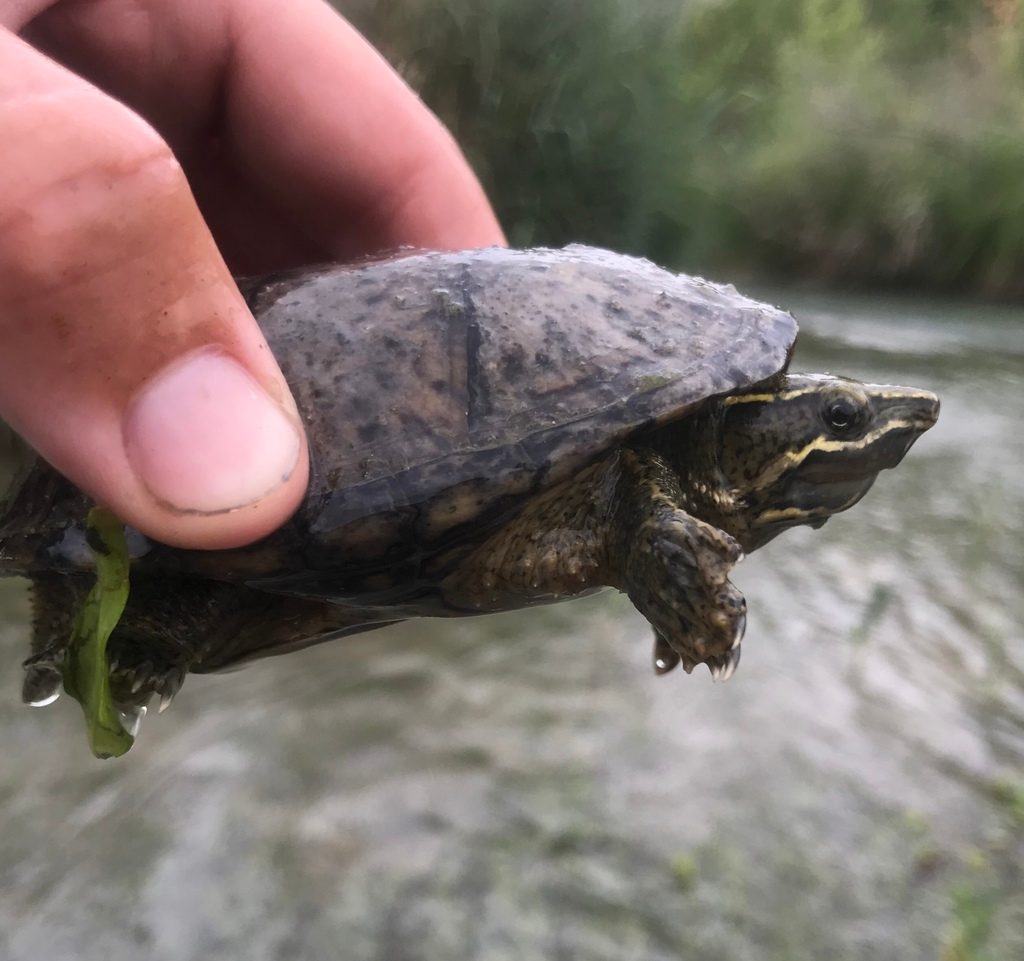
Photographed by an observer on iNaturalist and published under a Creative Commons licence; the photographer and the licence are named under the image. It is not an animal of ours, and no animal was handled by us to produce it.
The numbers
Thermal gradient
A real gradient, 32–35°C warm against 26–27°C cool, so the animal chooses. The sheet states no separate night figure.
Why
Same scale on every sheet here, so two species compare by eye.
The sheet stateswarm 32-35 °C / cool 26-27 °C
UVB
The sheet statesZoo Med T5 HO ReptiSun 5.0 or Arcadia Forest 6% | hung from the ceiling to land 13-14" above the basking spot to achieve a UVI of approximately 3.0-4.0 in the basking area
Identity
Enclosure and conditions
Enclosure
Drawn from the stated numbers. Only what the sheet states is drawn inside.
Why
The rectangle carries the exact width-to-height ratio of the figures above it, and the ruler under it places that width on the 0–250 cm scale every sheet here shares, so two species still compare at a glance. Nothing is added that the sheet does not name: a lamp drawn on a sheet that never mentions one would be invented equipment. What the sheet leaves out is listed rather than left blank, because an empty tank reads as « none needed ».
The sheet statesat least 20 gallons of water per inch of shell length in total capacity | a small (55"L x 24"W x 12"H) Waterland tub with 75% water area, 25% land area, and 6" water depth
What your climate adds
This sheet states a range to hold. Your local climate decides how much work holding it is. Pick the nearest city: nothing is sent anywhere, the choice stays in this browser.
Diet
Feeding rhythm
Twenty-eight days, one row. Each band is a meal window.
Why
The windows widen as they go because the interval is a range: four meals after a 10–14 day cycle land anywhere between day 40 and day 56.
The sheet statesMusk turtles younger than 6 months: protein food or pellets daily | Musk turtles older than 6 months: protein food or pellets every other day [and] vegetable food daily
Behaviour and handling
Reproduction
When to see a vet
Good to know
- Nicknamed 'stinkpot' for the musk it releases when alarmed. Stays tiny.
Common questions
Does it really smell?
It can release a musk when frightened, but a settled captive almost never does. Any tank smell comes from a weak filter.
Does it bite?
Yes, and the neck is long enough to reach right back over its own shell, so hold it at the very back of the shell.
How big does it get?
Small, about 8 to 13 cm, one of the best water turtles for a modest tank.
Does it need a basking lamp?
It baskets less than a slider but still needs a dry spot it can reach plus UV light. Keep the water shallow enough for it to walk up for air.
What it needs
Every line above is deduced from a value this sheet states, and names which one. Nothing here is a general recommendation.
Sources
Others in this group
What this sheet states
This sheet states 5 of 7 of the fields this product runs on. What is missing turns something off: humidity instrument and audit, the diet section. We show the gap rather than fill it with a plausible number.
UVB is measured but does not count: it is absent from 421 of 678 sheets, and on most of them that is not a gap, since a nocturnal snake's sheet has no reason to state a UV index. Counting it would call the library incomplete without cause.