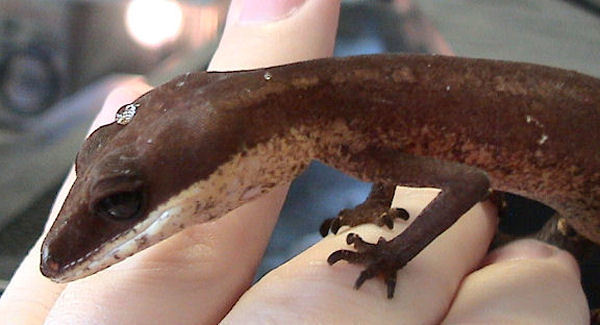
Photographed by an observer on iNaturalist and published under a Creative Commons licence; the photographer and the licence are named under the image. It is not an animal of ours, and no animal was handled by us to produce it.
The numbers
Thermal gradient
Day: a real gradient, 27–28°C warm against 21–24°C cool, so the animal chooses. Night: 19–21°C.
Why
Same scale on every sheet here, so two species compare by eye.
The sheet stateswarm 27-28 °C / cool 21-24 °C / night 19-21 °C
Humidity
The sheet states65-80% during the day with spikes up to 90-100% each night
UVB
The sheet statesThe 12" Arcadia ShadeDweller-Arboreal UVB ProT5 Kit is likely to work the best
Identity
Enclosure and conditions
What your climate adds
This sheet states a range to hold. Your local climate decides how much work holding it is. Pick the nearest city: nothing is sent anywhere, the choice stays in this browser.
Diet
Feeding rhythm
Twenty-eight days, one row. Each band is a meal window. The sheet gives several ages on one line; this is the adult figure.
Why
The windows widen as they go because the interval is a range: four meals after a 10–14 day cycle land anywhere between day 40 and day 56.
The sheet statescrickets, dubia roaches, discoid roaches, snails, isopods, hornworms, silkworms, black soldier fly larvae; Feed juveniles daily, and adults every other day. They don't need much, just 2-3 bugs slightly smaller than their head
Common questions
Is it hard to keep?
Yes, mostly because it comes from cool humid highland forest and suffers in a normal warm Thai room.
Can I handle it?
Short sessions are tolerated better than with most geckos because it is slow and gentle, but stress still counts.
What does it eat?
Small insects, and it hunts slowly and deliberately, so avoid dumping in fast prey that stresses it.
Can I keep two together?
A pair can work in a large planted enclosure. Males fight, so never two males.
What it needs
Every line above is deduced from a value this sheet states, and names which one. Nothing here is a general recommendation. What the sheet does not state is listed too, rather than left out: a kit that looks complete is worse than one that names its gap.
Sources
Others in this group
What this sheet states
This sheet states 4 of 7 of the fields this product runs on. What is missing turns something off: enclosure size audit, day/night engine and awake count on the globe, the diet section. We show the gap rather than fill it with a plausible number.
UVB is measured but does not count: it is absent from 421 of 678 sheets, and on most of them that is not a gap, since a nocturnal snake's sheet has no reason to state a UV index. Counting it would call the library incomplete without cause.