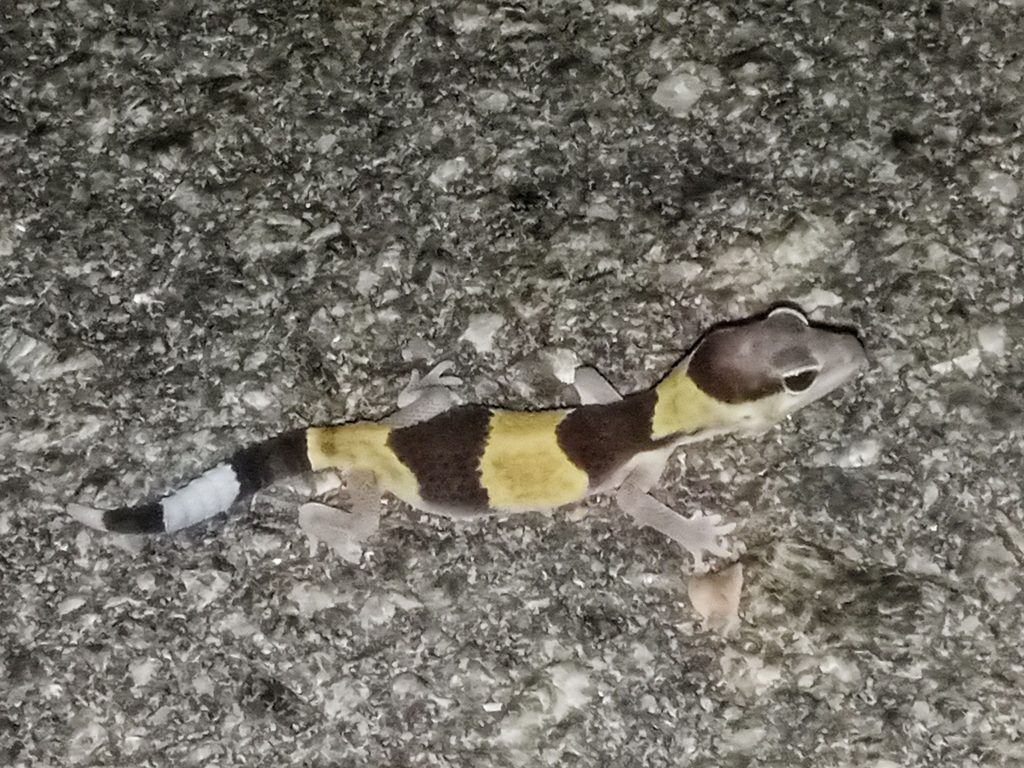
Can I keep it?
Setup
The numbers
Thermal gradient
Day: a real gradient, 32°C warm against 24–27°C cool, so the animal chooses. Night: 22–25°C.
Why
Same scale on every sheet here, so two species compare by eye.
The sheet stateswarm ~32 °C (90 °F) / cool 24-27 °C (75-80 °F) / night 22-25 °C (72-77 °F)
Humidity
The sheet statesWet season 70-80% / dry season ~50%
UVB
Not needed for this species
Stated in the sheet, not inferred.
The sheet statesnot strictly required (nocturnal) if a high-D3 calcium supplement is given, but recommended for best health outcomes
Part of this is not on the page we cite. We opened it on 10 Aug 2026 and some of the degrees above are not stated there. The values above may still be right, but we cannot show you where they came from, and nobody here has checked them against a second source. Anything about a sick animal goes to a qualified exotic vet, not to a page. reptifiles.com
Drag the sun. African Fat-tailed Gecko is Crepuscular, so what it is doing changes with the light. The sheet states a night temperature, and the rail follows it.
Enclosure and conditions
Enclosure
Drawn from the stated numbers. Only what the sheet states is drawn inside.
Why
The rectangle carries the exact width-to-height ratio of the figures above it, and the ruler under it places that width on the 0–250 cm scale every sheet here shares, so two species still compare at a glance. Nothing is added that the sheet does not name: a lamp drawn on a sheet that never mentions one would be invented equipment. What the sheet leaves out is listed rather than left blank, because an empty tank reads as « none needed ».
The sheet states90 × 45 × 45 cm
What your climate adds
This sheet states a range to hold. Your local climate decides how much work holding it is. Pick the nearest city: nothing is sent anywhere, the choice stays in this browser.
What it needs
Every line above is deduced from a value this sheet states, and names which one. Nothing here is a general recommendation.
- Terrarium 90×45×45
- Heat mat + thermostat
- Low UVB
- 3 hides incl. humid
- Coco substrate
- Calcium + D3
- Feeders + hygro/thermo
Food
Diet
Feeding rhythm
Twenty-eight days, one row. Each band is a meal window. This sheet states a figure for each age, so each age has its row.
Why
The windows widen as they go because the interval is a range: four meals after a 10–14 day cycle land anywhere between day 40 and day 56. A young animal's row is drawn only where the sheet gives one: working it out by dividing the adult interval would be inventing a ration.
The sheet statesInsects (crickets, dubia, BSF larvae) · 3–4×/week
Daily life
Behaviour and handling
Health
Common health problems
When to see a vet
This is not veterinary advice. If red flags appear, consult a qualified exotic (herp) veterinarian. Quarantine new arrivals 30–90 days.
Red flags
- open-mouth breathing
- months of weight loss
- stargazing
- persistent regurgitation
The species
Identity
Adult size
True scale, against a 1.75 m person
Logarithmic, the same axis on every sheet
The size the sheet states for a grown animal.
Why
Two drawings, because they answer two questions. The silhouette is at true scale against a 1.75 m person: it says how big this animal actually is, which no number does for someone who has never seen one. The bar under it is logarithmic and shared by every sheet here, so a 2 cm isopod and a 4 m python both stay readable on the same axis and two species can be compared at a glance.
Morphs
8 morphs, with how each one is inherited.
How common this animal is
NOT a measure of how many are kept. These filings count animals shipped for any purpose, including the food trade and laboratory supply, and they are United States records only. The three largest volumes in the source belong to a food frog, a bait species and the standard laboratory amphibian.
US Fish and Wildlife Service LEMIS declared wildlife import and export records, as compiled in the received dataset
Reproduction
Life course
Read from the lifespan and maturity the sheet states, for animals in care and not in the wild.
Why
The minimum commitment is the low end of that lifespan, and the reproductive window is what is left after maturity: both are subtractions on stated figures, not figures of their own.
Good to know
- Stores fat in its tail like a leopard gecko: but needs more humidity.
- A humid hide is non-negotiable for healthy sheds.
- Calmer, more laid-back disposition than the leopard gecko.
- Stores fat in its tail like a leopard gecko — but needs more humidity.
The way of life is written in this sheet, word for word. The climate words summarise the two figures above them, they do not add to them.
National law is not global, and we hold no national wildlife law for any country, Thailand included. Check your own authority before buying or selling.
Questions & sources
Common questions
Like a leopard gecko?
Similar, but more humidity-loving and even calmer.
Do they need a humid hide?
Yes: essential.
Handleable?
Yes: one of the calmest geckos.
Going deeper
Research dossier: read at the source, not yet cross-checked by our team. Every figure links to the page it was read on.
In the wild
Natural history extra
Northwest ghana field study
Field literaturethebhs.org
Development
Secondary academic summaryanimaldiversity.org
Wild ecology evidence
Northwest ghana capture conditions
Air temp c range
22.2-31.7
Relative humidity percent range
17-95
Field literaturethebhs.org
Wild size mass
Largest measured
Smallest probable hatchling
Captive hatchling reference from cited literature
Mass g range
1.2-2.5
Total length cm range
6.3-7
Field literaturethebhs.org
Habitat selection
Field literaturethebhs.org
Growth and body condition
Biology
Single source verifiedreptifiles.com
Growth
Adult mass observation
Observational summaryanimaldiversity.org
Breeding practice observations
Breeder practicereptilesmagazine.com
Breeder practicereptilesmagazine.com
Telling males from females
Sex
Male markers
- enlarged preanal pores
- more bulbous tail base in sexually mature males
Veterinary sexing
Male markers
- more massive head/neck
- prominent V-shaped preanal pores
Veterinary institutionalchuv.umontreal.ca
Single source verifiedanimaldiversity.org
Health and welfare
Health and biosecurity
Eublepharid gecko adenovirus
Veterinary outbreak reportpmc.ncbi.nlm.nih.gov
Systemic mastocytosis
Veterinary case reportpubmed.ncbi.nlm.nih.gov
Preventive veterinary
Veterinary institutionalchuv.umontreal.ca
Breeding
Reproduction intelligence
Breeding season
Secondary academic summaryanimaldiversity.org
Maturity
Secondary academic summaryanimaldiversity.org
Clutch
Mixed secondary and historical captiveanimaldiversity.org thebhs.org
Field female record
Egg dimensions cm
2.3-1.2
Field observationthebhs.org
Hatchling social stress
Secondary academic summaryanimaldiversity.org
Temperature sex determination
Secondary academic summaryanimaldiversity.org
Sexual dimorphism
Secondary academic summaryanimaldiversity.org
Breeder protocol
Readiness
Male
Female
Season
Laying
Female nutrition
Hatchling
Incubation
Incubation days female range
55-70
Incubation days male range
43-48
Breeder practicereptilesmagazine.com
Postlay gap
Housing through life
Life stage enclosure evidence
Breeder growout
Breeder practicereptilesmagazine.com
Veterinary length based rule
Rule
Veterinary institutionalchuv.umontreal.ca
Genetics and morphs
Genetics
Current repo findings
Evidence conflicts
Historical specialistgeckotime.com
Historical specialistgeckotime.com
Community consensus signalcommunity.morphmarket.com
Morph history 2012 snapshot
Traits
Current specialist reconciliation 2026
Findings
Current specialist model
Current specialist consensus
Current specialist consensus
Wild-caught or captive-bred
Trade history
Wild collection history
Field literaturethebhs.org
Iucndoi.org
Captive morph transition
Breeder industry historygeckotime.com
Breeder industry historygeckotime.com
Breeder industry opiniongeckotime.com
Genetics trade risks
Specialist historicalgeckotime.com
Togo export context
Academic trade reviewsciencedirect.com
https://keepr.pet/husbandry/en/hemitheconyx-caudicinctus
Others in this group
What this sheet states
Every field this product runs on is stated here. That is not a claim that the values are right: it says what the sheet states, not whether it is true. Whether a human has read it is the badge at the top of this page.
UVB is measured but does not count: it is absent from 420 of 678 sheets, and on most of them that is not a gap, since a nocturnal snake's sheet has no reason to state a UV index. Counting it would call the library incomplete without cause.