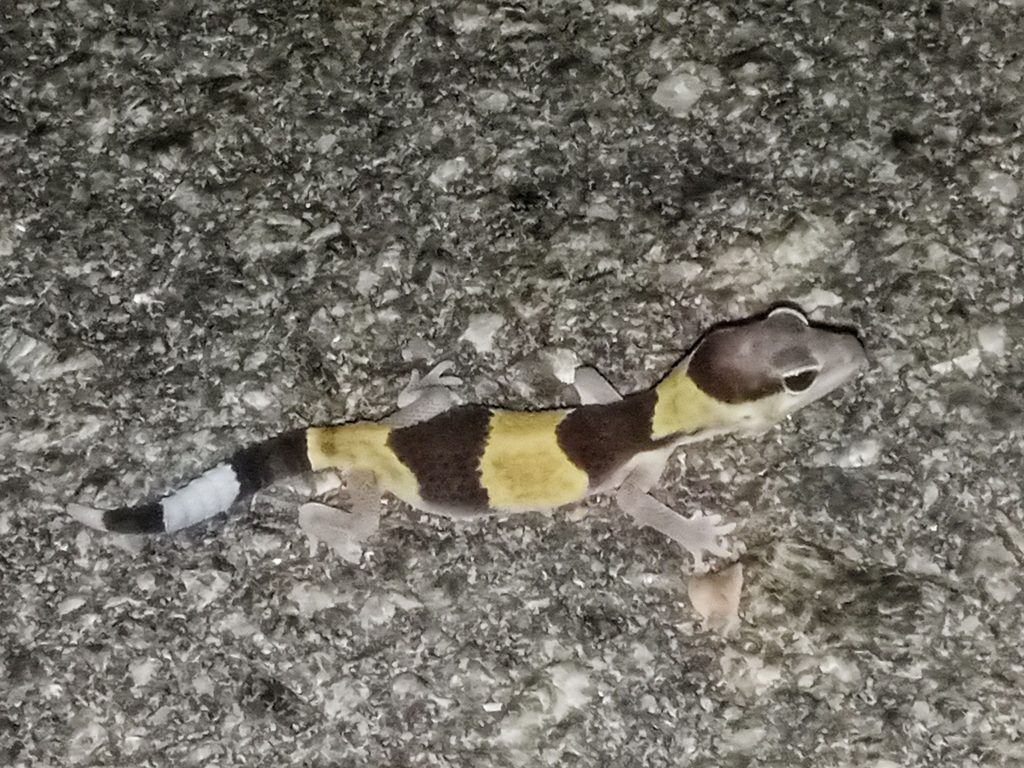
Puis-je le garder ?

Comparez votre installation à cette fiche

Installation

Les chiffres

Gradient thermique

152025303540 °C
24–27°Côté frais
32°Côté chaud
22–25°Nuit

Le jour, un vrai gradient : 32°C côté chaud contre 24–27°C côté frais, l'animal choisit. La nuit : 22–25°C.

Pourquoi

Même échelle sur toutes les fiches d'ici : deux espèces se comparent à l'œil.

La fiche énoncewarm ~32 °C (90 °F) / cool 24-27 °C (75-80 °F) / night 22-25 °C (72-77 °F)

Hygrométrie

70–80%Hygrométrie visée

La fiche énonceWet season 70-80% / dry season ~50%

UVB

Non nécessaire pour cette espèce

Énoncé dans la fiche, pas déduit.

La fiche énoncenot strictly required (nocturnal) if a high-D3 calcium supplement is given, but recommended for best health outcomes

Une partie de ceci n'est pas sur la page que nous citons. Nous l'avons ouverte le 10 août 2026 et certains des degrés ci-dessus n'y sont pas énoncés. Les valeurs ci-dessus sont peut-être justes, mais nous ne pouvons pas vous montrer d'où elles viennent, et personne ici ne les a confrontées à une deuxième source. Tout ce qui touche à un animal malade va à un vétérinaire spécialisé, pas à une page. reptifiles.com

14:00
Jour

Faites glisser le soleil. African Fat-tailed Gecko est Crépusculaire, donc ce qu'il fait change avec la lumière. La fiche énonce une température de nuit, et le rail la suit.

Terrarium et conditions EN

Terrarium

substrat32 °Cpoint d’eau70–80 % RH90 cm45 cm
côté chaudpoint d’eausubstrat
50100150200 cm
90 × 45 × 45 cmLargeur × profondeur × hauteur
41dm² au sol
Cachettes : pas encore dans nos donnéesUVB : pas encore dans nos données

Dessiné à partir des chiffres énoncés. Seul ce que la fiche énonce est dessiné dedans.

Pourquoi

Le rectangle porte le rapport exact largeur/hauteur des chiffres au-dessus de lui, et la réglette dessous place cette largeur sur l’échelle 0–250 cm que partagent toutes les fiches : deux espèces se comparent donc encore d’un coup d’œil. Rien n’est ajouté que la fiche ne nomme : une lampe dessinée sur une fiche qui n’en parle jamais serait du matériel inventé. Ce que la fiche tait est listé plutôt que laissé vide, parce qu’un bac vide se lit « rien à mettre ».

La fiche énonce90 × 45 × 45 cm

Cachette humide
Humid hide 85–100% on cool side — essential
Substrat
Coco / soil (holds some moisture)
Eau
Small dish

Ce que votre climat ajoute

Cette fiche énonce une fourchette à tenir. C'est votre climat qui décide du travail que ça demande. Choisissez la ville la plus proche : rien n'est envoyé nulle part, le choix reste dans ce navigateur.

Ce qu'il lui faut EN

Un bac d’au moins 90 × 45 × 45 cmparce que Terrarium — 90 × 45 × 45 cm
Une source de chaleurparce que Température — warm ~32 °C (90 °F) / cool 24-27 °C (75-80 °F) / night 22-25 °C (72-77 °F)
Un thermostat pour la régulerparce que Température — warm ~32 °C (90 °F) / cool 24-27 °C (75-80 °F) / night 22-25 °C (72-77 °F)
Un thermomètreparce que Température — warm ~32 °C (90 °F) / cool 24-27 °C (75-80 °F) / night 22-25 °C (72-77 °F)
De quoi vérifier la valeur de nuitparce que Température — warm ~32 °C (90 °F) / cool 24-27 °C (75-80 °F) / night 22-25 °C (72-77 °F)
Un hygromètreparce que Hygrométrie — Wet season 70–80% / dry season ~50%
Pas d’UVB : la fiche énonce qu’il n’en faut pasparce que UVB — not strictly required (nocturnal) if a high-D3 calcium supplement is given, but recommended for best health outcomes

Chaque ligne ci-dessus est déduite d’une valeur que cette fiche énonce, et elle dit laquelle. Rien ici n’est une recommandation générale.

  • Terrarium 90×45×45
  • Heat mat + thermostat
  • Low UVB
  • 3 hides incl. humid
  • Coco substrate
  • Calcium + D3
  • Feeders + hygro/thermo

Nourriture

Alimentation EN

Rythme alimentaire

Juvénile
tous les 1 d
Adulte
tous les 1.8–2.3 d
16Repas en 28 jours · adulte

Vingt-huit jours, une rangée. Chaque bande est une fenêtre de repas. Cette fiche énonce un chiffre par âge, donc chaque âge a sa rangée.

Pourquoi

Les fenêtres s'élargissent au fil du temps parce que l'intervalle est une fourchette : quatre repas après un cycle de 10 à 14 jours tombent n'importe où entre le 40e et le 56e jour. La rangée du jeune n’est dessinée que là où la fiche en donne une : la calculer en divisant l’intervalle adulte reviendrait à inventer une ration.

La fiche énonceInsects (crickets, dubia, BSF larvae) · 3–4×/week

Base de l'alimentation
Insects (crickets, dubia, BSF larvae)
Taille des proies
≤ space between the eyes
Juvéniles
Daily
Adultes
3–4×/week
Calcium
Dust most feeds; D3/multivit weekly

Au quotidien

Comportement et manipulation EN

ManipulationVery tolerant and calm
QueueDrops if grabbed (regrows differently)
CohabitationSolo; never 2 males
DéfenseRarely bites
Avec des enfantsGreat, supervised

Santé

Problèmes de santé fréquents EN

Metabolic bone disease
Signesweak/bent limbs
Préventioncalcium + D3 (+ low UVB)
Impaction
Signesloose substrate
Préventionfirm/appropriate substrate
Dysecdysis
Signesstuck shed
Préventionhumid hide is essential

Quand consulter un vétérinaire EN

This is not veterinary advice. If red flags appear, consult a qualified exotic (herp) veterinarian. Quarantine new arrivals 30–90 days.

Signaux d'alerte

  • open-mouth breathing
  • months of weight loss
  • stargazing
  • persistent regurgitation

L'espèce

Identité EN

Taille adulte

À l'échelle, contre une personne de 1,75 m

1,75 m20–25 cm

Échelle logarithmique, la même sur toutes les fiches

1520100400 cm
20–25 cmDu museau à la queue, adulte

La taille que la fiche énonce pour un animal adulte.

Pourquoi

Deux dessins, parce qu’ils répondent à deux questions. La silhouette est à l’échelle réelle contre une personne d’1,75 m : elle dit à quel point l’animal est grand, ce qu’aucun nombre ne fait pour quelqu’un qui n’en a jamais vu. La barre en dessous est logarithmique et partagée par toutes les fiches d’ici : un cloporte de 2 cm et un python de 4 m y restent lisibles sur le même axe, et deux espèces se comparent d’un coup d’œil.

Famille / ordre
Eublepharidae / Squamata
Taille adulte
20–25 cm
Longévité (en captivité)
15–20 yrs
Activité
Crepuscular / nocturnal; terrestrial
Tempérament
Very docile, calm (calmer than leopard gecko)

Morphs

8 morphs, avec le mode de transmission de chacun.

Sans risque connu8couleur et motif seulement
Amelanistic (Albino)RécessifForme super : —
Caramel / GhostRécessifForme super : —
OreoRécessifForme super : —
Stripe / AberrantSélection polygéniqueForme super : —
TangerineSélection polygéniqueForme super : —
White-outCodominantForme super : —
Zero / PatternlessRécessifForme super : —
ZuluSélection polygéniqueLocality-basedForme super : —

À quel point cet animal est répandu

197,408Individus vivants dans les déclarations d'importation américaines

Ce n'est PAS une mesure du nombre d'animaux gardés. Ces déclarations comptent les animaux expédiés pour n'importe quel usage, y compris le commerce alimentaire et l'approvisionnement des laboratoires, et ce sont des registres des États-Unis uniquement. Les trois plus gros volumes de la source sont une grenouille de consommation, une espèce servant d'appât et l'amphibien de laboratoire standard.

Registres de déclaration d'importation et d'exportation de faune LEMIS du US Fish and Wildlife Service, tels que compilés dans le jeu de données reçu

Reproduction EN

Parcours de vie

Jour 0Éclosion
0.8–1 yrMaturité sexuelle
15–20 yrLongévité en captivité
50–70 dIncubation
2 eggs, several clutchesPonte
15 yrEngagement minimum
~14 yrFenêtre de reproduction

Lu sur la longévité et la maturité que la fiche énonce, pour des animaux en captivité et non dans la nature.

Pourquoi

L'engagement minimum est la borne basse de cette longévité, et la fenêtre de reproduction est ce qui reste après la maturité : ce sont deux soustractions sur des valeurs énoncées, pas des valeurs à part entière.

Maturité sexuelle
~9–12 months
Sexage
♂ preanal pores + hemipenal bulges
Ponte
2 eggs, several clutches
Incubation
~50–70 days; temperature sets sex

Bon à savoir EN

  • Stores fat in its tail like a leopard gecko: but needs more humidity.
  • A humid hide is non-negotiable for healthy sheds.
  • Calmer, more laid-back disposition than the leopard gecko.
  • Stores fat in its tail like a leopard gecko — but needs more humidity.
Terrestre · chaud · humideD'après la fiche : extrémité chaude 32°C, hygrométrie 70–80%

Le mode de vie est écrit dans cette fiche, mot pour mot. Les mots de climat résument les deux valeurs au-dessus d'eux, ils n'y ajoutent rien.

Le droit national n'est pas mondial, et nous ne détenons le droit de la faune d'aucun pays, Thaïlande comprise. Vérifiez auprès de l'autorité de votre pays avant d'acheter ou de vendre.

Questions et sources

Questions fréquentes EN

Like a leopard gecko?

Similar, but more humidity-loving and even calmer.

Do they need a humid hide?

Yes: essential.

Handleable?

Yes: one of the calmest geckos.

Pour aller plus loin EN

Dossier de recherche : lu à la source, pas encore recoupé par notre équipe. Chaque chiffre renvoie à la page où il a été lu.

Dans la nature

Natural history extra

Northwest ghana field study

Study period
1979-1981
Sample size
24
Activity
23 of 24 specimens were found during nocturnal searching; one was dug from a burrow by day.
Climate
Single rainy season roughly April-September; dry-season Harmattan; field paper reports broad daily temperature ranges.
Male combat
Paper cites captive observations of violent male combat resulting in death.

Field literaturethebhs.org

Development

Hatchling mass g about
4
Sex growth
Growth similar until roughly 350 days, then males diverge larger and develop male-specific pores.

Secondary academic summaryanimaldiversity.org

Wild ecology evidence

Northwest ghana capture conditions

Source period
1980-1981 observations in published 2008 field paper
Measured captures
20
Pattern
Animals were observed active at night across both very dry and rainy-season conditions; body temperatures, when measured, generally tracked air/substrate context.

Air temp c range

22.2-31.7

Relative humidity percent range

17-95

Field literaturethebhs.org

Wild size mass

Largest measured

Total length mm
196
Snout vent length mm
141
Tail length mm
55
Mass g
56.2

Smallest probable hatchling

Total length mm
60
Snout vent length mm
48
Tail length mm
12
Mass g
2.13

Captive hatchling reference from cited literature

Mass g range

1.2-2.5

Total length cm range

6.3-7

Field literaturethebhs.org

Habitat selection

Finding
Most captures in the Wa study were in open savanna and away from rock outcrops; the author inferred sheltering in holes/burrows.

Field literaturethebhs.org

Croissance et état corporel

Biology

Native range
West Africa, Senegal to northern Cameroon
Habitat
dry Sahel and dry/moist savannah; rock crevices/leaf litter
Adult length
about 8-10 in in current husbandry guidance
Captive lifespan years
15-20 typical

Single source verifiedreptifiles.com

Growth

Rule
Weight records are observations/practices, not universal healthy targets.

Adult mass observation

Range g
40-90
Average g
50
Context
Animal Diversity Web species summary

Observational summaryanimaldiversity.org

Breeding practice observations

Sex
male
Minimum age months
7
Minimum weight g
40
Context
breeder practice

Breeder practicereptilesmagazine.com

Sex
female
Minimum age months
8
Minimum weight g
45
Context
breeder practice; productive females in that colony reported 45-55 g

Breeder practicereptilesmagazine.com

Distinguer mâles et femelles

Sex

Dimorphism
males average larger than females

Male markers

  • enlarged preanal pores
  • more bulbous tail base in sexually mature males

Veterinary sexing

Earliest reported age
about 1 month
Note
Sexing ability is distinct from sexual maturity; do not use early visual sexing as breeding readiness.

Male markers

  • more massive head/neck
  • prominent V-shaped preanal pores

Veterinary institutionalchuv.umontreal.ca

Single source verifiedanimaldiversity.org

Santé et bien-être

Health and biosecurity

Eublepharid gecko adenovirus

Finding
A disease outbreak involving fat-tail geckos included wasting, high mortality, lymphoplasmacytic enteritis with intranuclear inclusions, and pancreatitis; an eublepharid gecko adenovirus was detected.

Veterinary outbreak reportpmc.ncbi.nlm.nih.gov

Systemic mastocytosis

Finding
First reported mast-cell neoplasia in geckos was described in a 3-year-old female AFT with sudden lethargy/death and multisystem disease.

Veterinary case reportpubmed.ncbi.nlm.nih.gov

Preventive veterinary

Routine exam
Annual physical examination recommended by Université de Montréal CHUV.

Veterinary institutionalchuv.umontreal.ca

Reproduction

Reproduction intelligence

Breeding season

Value
approximately November-March in summarized literature

Secondary academic summaryanimaldiversity.org

Maturity

Female days
250-300 average reported
Male days
300-350 average reported

Secondary academic summaryanimaldiversity.org

Clutch

Eggs per clutch
1-3 summarized range; older captive reports commonly 1-2
Maximum clutches
up to five in a breeding season in ADW summary; older captive literature cited five batches of two eggs in ~6 months and another husbandry source up to eight clutches/year

Mixed secondary and historical captiveanimaldiversity.org thebhs.org

Field female record

Female mass g
10.8
Total length mm
126
Capture date
1981-03-28
Egg laid date
1981-04-16
Egg mass g
1.8
Outcome
failed to hatch
Use
Natural-history observation only; not a recommended breeding weight.

Egg dimensions cm

2.3-1.2

Field observationthebhs.org

Hatchling social stress

Finding
ADW summarizes captive observations that hatchlings may be intimidated by older/adult geckos, with reduced feeding/stress when forced into proximity.

Secondary academic summaryanimaldiversity.org

Temperature sex determination

Low incubation c
24-28 → predominantly female in summarized experimental literature
Mixed incubation c
29-30.5 → roughly mixed sexes
Higher incubation c
31-32 → mostly male
Caveat
Use as species-level reproductive biology, not a guaranteed sexing calculator for an individual egg.

Secondary academic summaryanimaldiversity.org

Sexual dimorphism

Finding
Males become larger than females after roughly 350 days and develop male-specific pores; larger males may have greater reproductive success in summarized literature.

Secondary academic summaryanimaldiversity.org

Breeder protocol

Readiness

Caveat
Single breeder colony practice/observation, not universal biological threshold.

Male

Min age months
7
Min weight g
40

Female

Min age months
8
Min weight g
45

Season

Natural reference
November-March
Breeder observed
Most breeding October-May, often starting December-January
Cooling optional
yes
Cooling duration weeks
4-6
Caveat
Breeder protocol; cooling is described as helpful but not necessary.

Laying

Typical eggs per clutch
2
Occasional small female clutch
1
Clutches per year
3-5 typical in this breeder colony
Egg length in
1-1.5

Female nutrition

Protocol
Feed breeding females heavily/as much as they will take during breeding season; supplement prey with vitamins and calcium at every feeding.

Hatchling

Mean hatch weight g
4
Length in
2.5-3
First feeding
A couple of days after hatching in this breeder protocol
Adult housing transition weight g
15

Incubation

Female biased f
83-85
Male biased f
88-89
Female biased high f
>90 reported
Caveat
Historical breeder protocol; use scientific TSD sources for canonical sex-determination modeling.

Incubation days female range

55-70

Incubation days male range

43-48

Breeder practicereptilesmagazine.com

Postlay gap

Finding
Current sources provide breeding-season feeding/calcium practice but no robust controlled post-lay recovery protocol specific to AFT.
Le logement au fil de la vie

Life stage enclosure evidence

Unresolved
Modern dimensional minimum for hatchlings/juveniles remains insufficiently established. Do not downscale adult size by formula.

Adult

Minimum in

L
36
W
18
H
16

Approximate cm

L
91
W
46
H
41

Specialist husbandryreptifiles.com

Breeder growout

Hatchlings
Breeder article used Vision hatchling rack systems or shoebox-size containers.
Transition weight g
15
Transition
At 15 g, that breeder moved animals to subadult/adult housing.
Caveat
This is breeder workflow evidence, not a universal minimum enclosure prescription. KEEPR may use 15 g as a historical grow-out transition signal only.

Breeder practicereptilesmagazine.com

Veterinary length based rule

Use
Useful individualized geometry rule when actual body length is known, especially before adulthood. It does not override KEEPR's larger adopted adult floor-space standard.

Rule

Enclosure length
2-3 × animal total length
Enclosure depth
1-1.5 × animal total length
Enclosure height
1.5-2 × animal total length

Veterinary institutionalchuv.umontreal.ca

Génétique et morphes

Genetics

Canonical status
audit_required

Current repo findings

Trait
Amelanistic
Repo inheritance
recessive
Trait
Oreo
Repo inheritance
recessive
Trait
White Out
Repo inheritance
codominant
Trait
Zero / Patternless
Repo inheritance
recessive
Trait
Caramel / Ghost
Repo inheritance
recessive combined label
Trait
Tangerine
Repo inheritance
polygenic
Trait
Stripe / Aberrant
Repo inheritance
polygenic
Trait
Zulu
Repo inheritance
polygenic/locality-based

Evidence conflicts

Topic
Stinger / Zero / Patternless
Finding
2012 specialist morph guide describes Patternless as recessive, Super Stinger and Super Zero as recessive/allelic with Patternless, while the visible Stinger/Zero phenotype had historically been interpreted as a possible heterozygous marker and was still described as not fully proven.

Historical specialistgeckotime.com

Topic
White Out
Finding
2012 specialist guide records White Out as co-dominant and Super White Out as lethal, reporting hatchlings dying within hours.

Historical specialistgeckotime.com

Topic
Ghost / Caramel / Amel female issues
Finding
MorphMarket community records repeatedly report female infertility for Ghost and Caramel, and disputed/line-dependent reproductive or combo issues for Amel.

Community consensus signalcommunity.morphmarket.com

Morph history 2012 snapshot

Source date
2012-12-04
Caveat
Historical hobby classifications are preserved as a dated snapshot, not automatically promoted to current canonical genetics.

Traits

Trait
Stripe
Inheritance reported
dominant
Trait
Albino/Amel
Inheritance reported
recessive
Trait
Caramel Albino
Inheritance reported
recessive
Trait
Patternless
Inheritance reported
recessive
Trait
Ghost
Inheritance reported
recessive
Trait
Anery/Oreo
Inheritance reported
recessive
Trait
Zulu
Inheritance reported
recessive
Trait
Super Stinger
Inheritance reported
recessive and allelic with Patternless
Trait
Super Zero
Inheritance reported
recessive and allelic with Patternless
Trait
White Out
Inheritance reported
co-dominant in historical hobby terminology
Trait
Super White Out
Inheritance reported
historically reported lethal
Trait
Aberrant/Jungle
Inheritance reported
polygenic / line bred
Trait
Starburst
Inheritance reported
polygenic / line bred
Trait
Granite
Inheritance reported
polygenic / line bred

geckotime.com

Current specialist reconciliation 2026

Measured at
2026-09-27

Findings

Topic
Zero / Stinger / Stripe
Current model
Zero is modeled as Stinger plus Stripe rather than an independent gene.

Current specialist model

Topic
Super White Out
Current model
Excluded as a viable parent; offspring calculations mark the super state non-viable.

Current specialist consensus

Topic
Ghost / Caramel females
Current model
Visual females are widely reported infertile, but proven fertile exceptions exist.

Current specialist consensus

Topic
possible het labels
Current model
66%/33% possible het probabilities are used heavily in the AFT market.

ryangstudio.com

Prélevé ou né en captivité

Trade history

Wild collection history

Period
2008 literature snapshot
Fact
Popular in pet trade and sometimes captive bred, but significantly large numbers were also taken from the wild; impact was unassessed and the paper noted no CITES quotas at that time.

Field literaturethebhs.org

Period
2013 IUCN assessment
Fact
International pet-trade exploitation was recorded particularly in Ghana, Togo and Benin; collection may pose a local threat.

Iucndoi.org

Captive morph transition

Period
about 2006-2012
Fact
Specialist retrospective described rapid new morph/genetics development; by 2012 White Out, Oreo, Zulu, Patternless, Ghost and other projects were documented.

Breeder industry historygeckotime.com

Period
2008 breeder recollection
Fact
One breeder reported becoming interested while working at a reptile breeder/wholesaler that had just received an imported group.

Breeder industry historygeckotime.com

Period
2017 breeder retrospective

Breeder industry opiniongeckotime.com

Genetics trade risks

Trait
Ghost
Issue
Visual female infertility is widely reported in specialist breeder/community records but is not yet established here with primary genetics/veterinary evidence.

community.morphmarket.com

Trait
Caramel/Amel lines
Issue
Female fertility/egg-laying problems are reported in specialist breeder discussions; likely line/trait dependent and not ready for canonical advice.

community.morphmarket.com

Trait
White Out
Issue
Super White Out non-viability has been reported for years in specialist sources.

Specialist historicalgeckotime.com

Togo export context

Finding
Peer-reviewed review identifies Togo as a major hub for intercontinental live African reptile exports and lists H. caudicinctus among species with constant international demand.
Implication
Export country can be a trade hub rather than precise wild origin; provenance/locality claims require stronger evidence.

Academic trade reviewsciencedirect.com

Retour a l'Atlas Mon carnet

https://keepr.pet/husbandry/fr/hemitheconyx-caudicinctus

Autres espèces du même groupe

Ce que cette fiche énonce

100%
TempératureHygrométrieTaille du terrariumActivitéOrigineAlimentationSourcesUVB

Tous les champs dont ce produit se sert sont énoncés ici. Ce n'est pas une affirmation que les valeurs sont justes : cela dit ce que la fiche énonce, pas si c'est vrai. Qu'un humain l'ait relue ou non, c'est la pastille en haut de cette page qui le dit.

L'UVB est mesuré mais ne compte pas : il est absent de 420 fiches sur 678, et sur la plupart ce n'est pas un trou, puisque la fiche d'un serpent nocturne n'a aucune raison d'énoncer un indice UV. Le compter dirait la bibliothèque incomplète sans motif.