Setup
The numbers
Thermal gradient
Day: a real gradient, 35°C warm against 21–26°C cool, so the animal chooses. Night: 18°C.
Why
Same scale on every sheet here, so two species compare by eye.
The sheet stateswarm 35 °C / cool 21-26 °C / night 18 °C
UVB
Not needed for this species
Stated in the sheet, not inferred.
The sheet statesA full spectrum UV light is not required for the maintenance of D. couperi, but it is recommended
Narrower than the page we cite. The source we cite, read on 10 Aug 2026, gives a wider range than the one above. The narrowing is ours and nobody here has written down why. reptilesupply.com
Drag the sun. The sheet states a night temperature, so the rail follows it.
Enclosure and conditions
Enclosure
Drawn from the stated numbers. Only what the sheet states is drawn inside.
Why
The rectangle carries the exact width-to-height ratio of the figures above it, and the ruler under it places that width on the 0–250 cm scale every sheet here shares, so two species still compare at a glance. Nothing is added that the sheet does not name: a lamp drawn on a sheet that never mentions one would be invented equipment. What the sheet leaves out is listed rather than left blank, because an empty tank reads as « none needed ».
The sheet statesat least 1.83mL X 0.61mW X 0.61mH (72"L X 24"W X 24"H) for single adult specimens
What your climate adds
This sheet states a range to hold. Your local climate decides how much work holding it is. Pick the nearest city: nothing is sent anywhere, the choice stays in this browser.
What it needs
Every line above is deduced from a value this sheet states, and names which one. Nothing here is a general recommendation.
Food
Diet
Feeding rhythm
Twenty-eight days, one row. Each band is a meal window. The sheet gives several ages on one line; this is the adult figure.
Why
The windows widen as they go because the interval is a range: four meals after a 10–14 day cycle land anywhere between day 40 and day 56.
The sheet statesrodent prey items; young fed weekly or three times biweekly, adults once a week or every 10 days
The species
National law is not global, and we hold no national wildlife law for any country, Thailand included. Check your own authority before buying or selling.
Questions & sources
Common questions
How much space does it need?
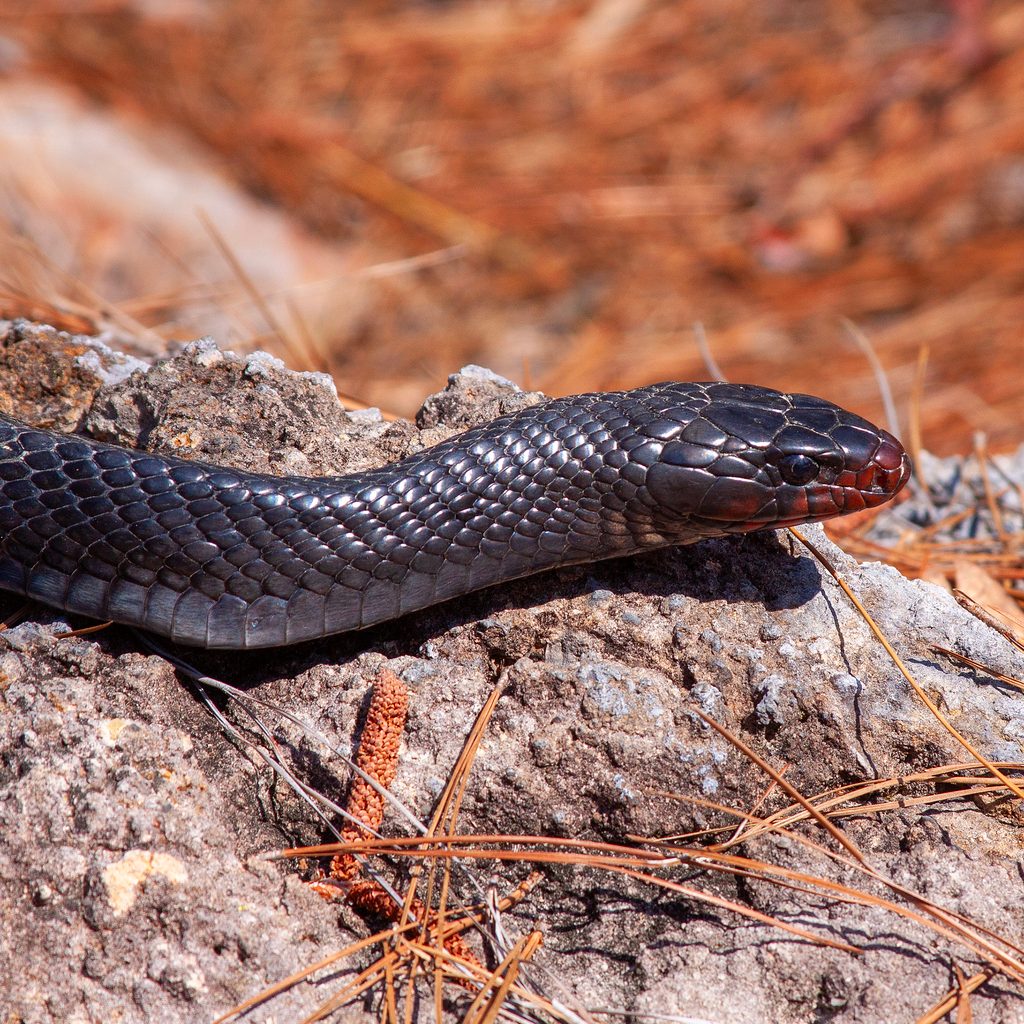
A lot. It reaches 2 to 2.5 metres and is constantly on the move, so it needs a custom room-sized enclosure.
Is it dangerous?
Not venomous, but it is big, fast and strong-jawed, and it swallows quickly around food. A serious bite is possible.
What does it eat and how much does it cost?
Rodents and a big appetite. Feeding this species costs more than any other colubrid on this site.
Is it tame?
Usually confident and calm rather than aggressive, but its strength means careful two-hand support and tong feeding.
https://keepr.pet/husbandry/en/drymarchon-couperi
Others in this group
What this sheet states
This sheet states 5 of 7 of the fields this product runs on. What is missing turns something off: humidity instrument and audit, day/night engine and awake count on the globe. We show the gap rather than fill it with a plausible number.
UVB is measured but does not count: it is absent from 420 of 678 sheets, and on most of them that is not a gap, since a nocturnal snake's sheet has no reason to state a UV index. Counting it would call the library incomplete without cause.