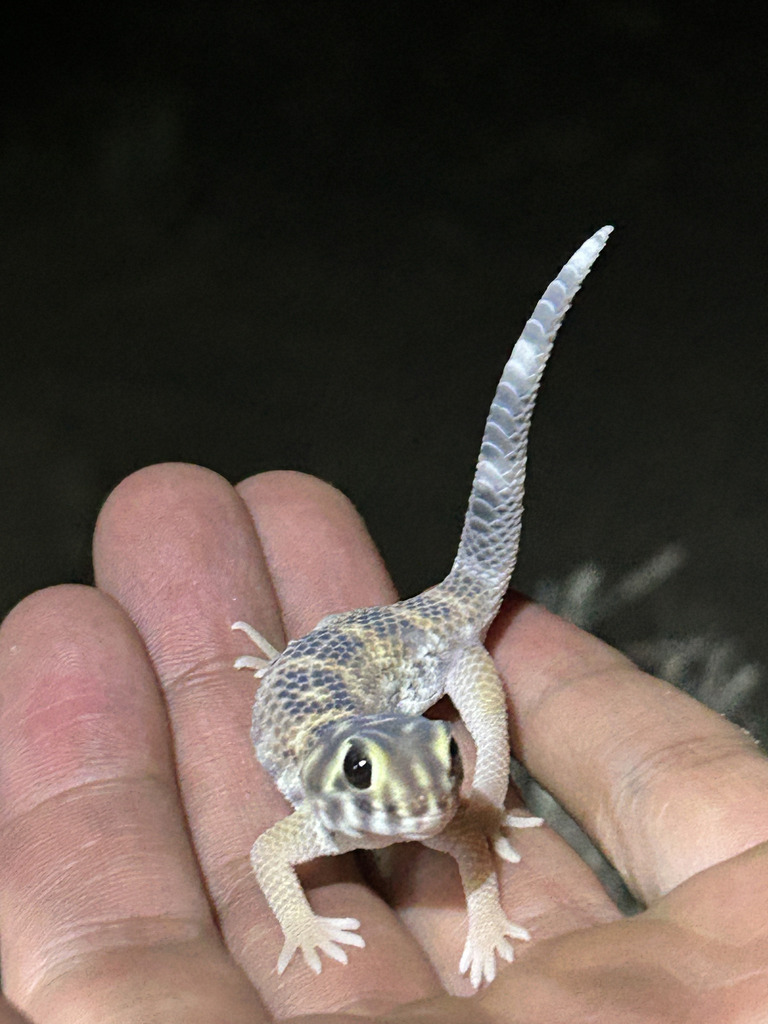
Photographed by an observer on iNaturalist and published under a Creative Commons licence; the photographer and the licence are named under the image. It is not an animal of ours, and no animal was handled by us to produce it.
The numbers
Thermal gradient
Day: a real gradient, 30–32°C warm against 22–25°C cool, so the animal chooses. Night: 15°C.
Why
Same scale on every sheet here, so two species compare by eye.
The sheet stateswarm 30-32 °C / cool 22-25 °C / night 15 °C
Humidity
The sheet statesthe required 40%
UVB
The sheet states2 - 3 UVI (7% Shade Dweller or 6% T5 - enclosure height dependent)
Identity
Enclosure and conditions
Enclosure
Drawn from the stated numbers. Only what the sheet states is drawn inside.
Why
The rectangle carries the exact width-to-height ratio of the figures above it, and the ruler under it places that width on the 0–250 cm scale every sheet here shares, so two species still compare at a glance. Nothing is added that the sheet does not name: a lamp drawn on a sheet that never mentions one would be invented equipment. What the sheet leaves out is listed rather than left blank, because an empty tank reads as « none needed ».
The sheet statesminimum of a 3 x 2 x 2ft enclosure
What your climate adds
This sheet states a range to hold. Your local climate decides how much work holding it is. Pick the nearest city: nothing is sent anywhere, the choice stays in this browser.
Common questions
Does it make noise?
Yes, it squeaks and rattles its tail scales when annoyed, and it is surprisingly loud for such a small animal.
Can I handle it?
Very little. Its skin is famously thin and tears if you grip it, so scoop rather than grab.
What do I need for it?
A deep dry sand bed for burrowing, solid hides and a dry basking area at one end.
Does it bite?
Rarely, and it is far too small to do any harm.
What it needs
Every line above is deduced from a value this sheet states, and names which one. Nothing here is a general recommendation.
Sources
Others in this group
What this sheet states
This sheet states 5 of 7 of the fields this product runs on. What is missing turns something off: day/night engine and awake count on the globe, the diet section. We show the gap rather than fill it with a plausible number.
UVB is measured but does not count: it is absent from 421 of 678 sheets, and on most of them that is not a gap, since a nocturnal snake's sheet has no reason to state a UV index. Counting it would call the library incomplete without cause.