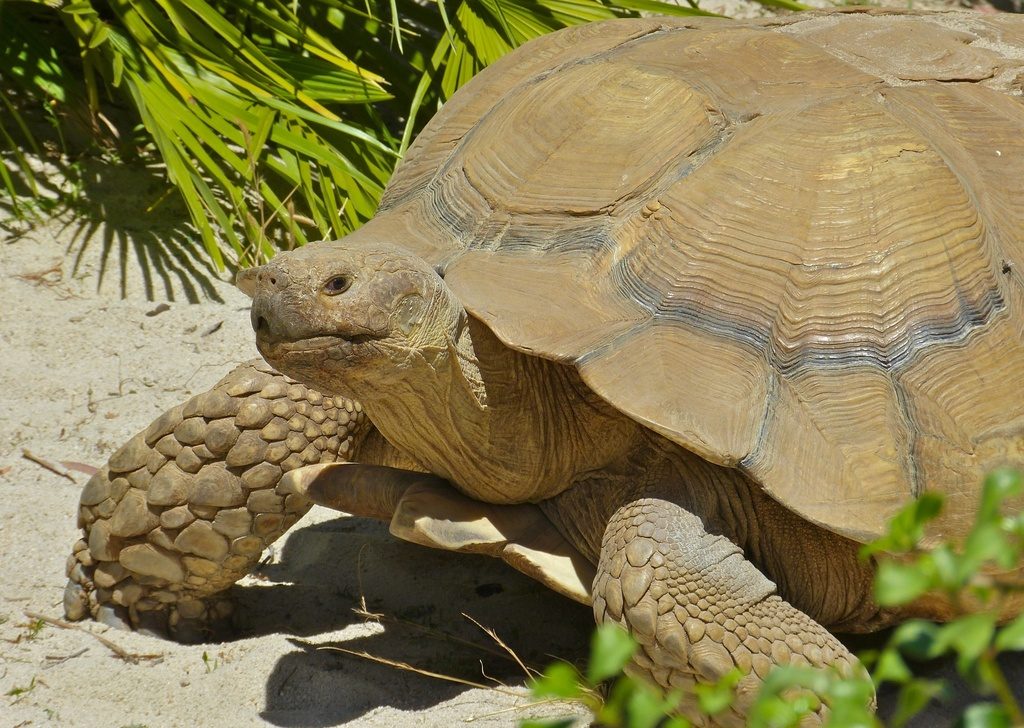
Can I keep it?
Setup
The numbers
Temperature
The cool side, 27–32°C, dropping to 21–23°C at night. This sheet states the cool side only. It gives no warm side or basking figure, so the hot end is not in our data. Same scale on every sheet here, so two species compare by eye.
The sheet statescool 27-32 °C / night 21-23 °C
Humidity
The sheet statesJuveniles: always >80%, higher at night. Adults are more resilient to drying out and are kept in a dry, well ventilated enclosure, with a humid hide always available (the burrow they dig in the wild)
UVB
The sheet statesArcadia T5 HO Desert 12% or Zoo Med T5 HO ReptiSun 10.0 at 9-12″ /23-31cm (mesh), 14-16″ / 36-41cm (no mesh); Arcadia T5 HO Dragon 14% at 10-13″ / 25-33cm (mesh), 15-20″ / 38-51cm (no mesh); achieve a UVI of between 4.0 – 6.0 in the basking area
Traceable. The figures above appear in the page we cite, which we opened on 10 Aug 2026. That means you can check them, not that we have confirmed they are right. reptifiles.com
Drag the sun. African spurred tortoise is Diurnal, so what it is doing changes with the light. The sheet states a night temperature, and the rail follows it.
Enclosure and conditions
What your climate adds
This sheet states a range to hold. Your local climate decides how much work holding it is. Pick the nearest city: nothing is sent anywhere, the choice stays in this browser.
What it needs
Every line above is deduced from a value this sheet states, and names which one. Nothing here is a general recommendation. What the sheet does not state is listed too, rather than left out: a kit that looks complete is worse than one that names its gap.
Food
Diet
Feeding rhythm
Twenty-eight days, one row. Each band is a meal window.
Why
The windows widen as they go because the interval is a range: four meals after a 10–14 day cycle land anywhere between day 40 and day 56.
The sheet statesSulcata tortoises are herbivores, which means that they eat plants. Young and growing sulcata tortoises should be given as much as they can eat every day. Once they near adulthood, this should be reduced to a limited quantity (roughly the same size as their shell) daily to prevent obesity
Daily life
Behaviour and handling
Health
When to see a vet
Pyramiding & stones are husbandry; big adults need space + a vet who handles large chelonians.
The species
Identity
Reproduction
Good to know
- Third-largest tortoise on Earth and the largest mainland species.
The way of life is written in this sheet, word for word. The climate words summarise the two figures above them, they do not add to them.
CITES II is a global listing and holds in every country. National law is not global, and we hold no national wildlife law for any country, Thailand included. Check your own authority before buying or selling.
Questions & sources
Common questions
How big does it really get?
Very big: 60 to 80 cm and often 40 to 80 kg. Most people underestimate this and end up having to rehome it.
Can it live in an apartment?
Honestly, no. An adult needs a garden it can graze and dig in, with a solid shelter.
Does it dig?
Constantly, and it will tunnel under fences and walls. Sink your barrier deep or you will be chasing it down the soi.
How long does it live?
Seventy years or more, so this is a decision for the whole family.
https://keepr.pet/husbandry/en/centrochelys-sulcata
Others in this group
What this sheet states
Every field this product runs on is stated here. That is not a claim that the values are right: it says what the sheet states, not whether it is true. Whether a human has read it is the badge at the top of this page.
UVB is measured but does not count: it is absent from 420 of 678 sheets, and on most of them that is not a gap, since a nocturnal snake's sheet has no reason to state a UV index. Counting it would call the library incomplete without cause.