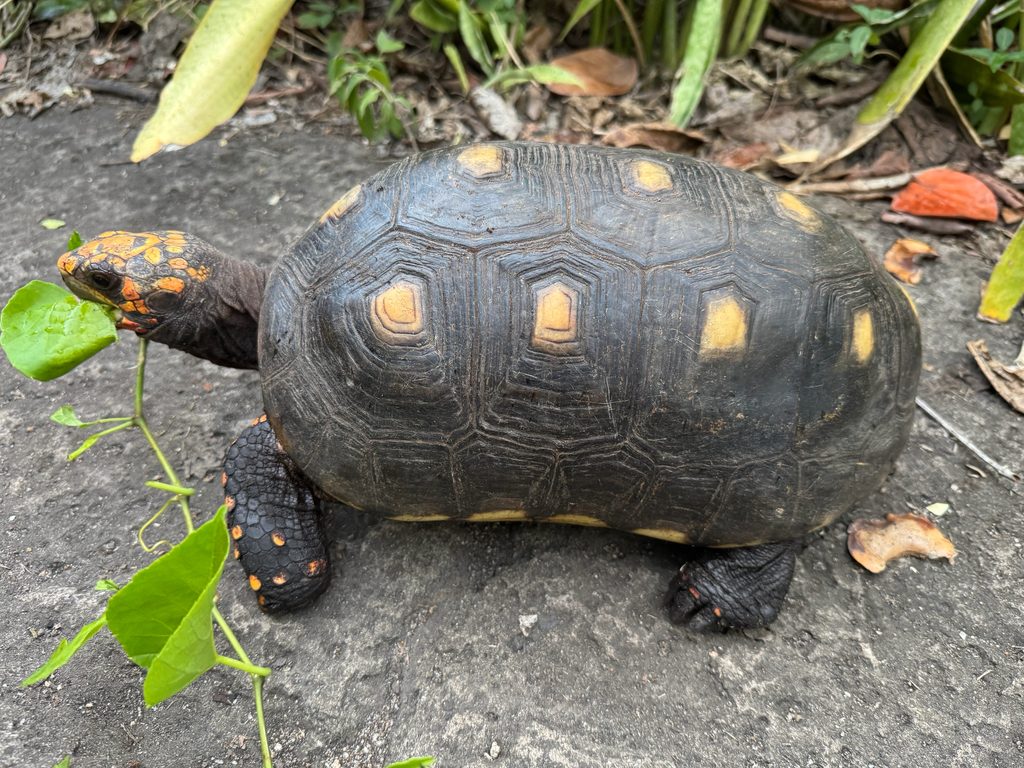
Setup
The numbers
Thermal gradient
Day: a real gradient, 32–35°C warm against 24–29°C cool, so the animal chooses. Night: 20–23°C.
Why
Same scale on every sheet here, so two species compare by eye.
The sheet stateswarm 32-35 °C / cool 24-29 °C / night 20-23 °C
Humidity
The sheet states70-90 % en interieur
UVB
The sheet statesArcadia T5 HO 6% / Zoo Med T5 HO Reptisun 5.0 at mesh: 11-14″ / 28-35cm, no mesh: 14-17″ / 35-43cm; Arcadia T5 HO 12% / Zoo Med T5 HO ReptiSun 10.0 at mesh: 17-22″ /43-55cm, no mesh: 21-25″ / 53-62cm; UVI between 2.0 – 3.0 in the basking area
Traceable. The figures above appear in the page we cite, which we opened on 10 Aug 2026. That means you can check them, not that we have confirmed they are right. reptifiles.com
Drag the sun. Red-footed tortoise is Diurnal, so what it is doing changes with the light. The sheet states a night temperature, and the rail follows it.
Enclosure and conditions
What your climate adds
This sheet states a range to hold. Your local climate decides how much work holding it is. Pick the nearest city: nothing is sent anywhere, the choice stays in this browser.
What it needs
Every line above is deduced from a value this sheet states, and names which one. Nothing here is a general recommendation. What the sheet does not state is listed too, rather than left out: a kit that looks complete is worse than one that names its gap.
Daily life
Behaviour and handling
Health
When to see a vet
Humid forest tortoise — needs higher humidity than Sulcata/Leopard. Moderate fruit is fine.
The species
Identity
Reproduction
Good to know
- One of few tortoises that eats fruit & carrion in the wild: and 'talks'.
CITES II is a global listing and holds in every country. National law is not global, and we hold no national wildlife law for any country, Thailand included. Check your own authority before buying or selling.
Questions & sources
Common questions
Is it a good tortoise for Thailand?
One of the better matches, because it comes from humid tropical forest, so our climate suits it far better than it suits desert species.
What does it eat?
Greens as the base, a real share of fruit, and a little animal protein now and then, which is unusual for a tortoise.
How big does it get?
Around 30 to 40 cm, occasionally larger, so a small garden pen is manageable.
Can I keep two?
Females together are usually fine, but two males will ram and bite each other. Give them room and two separate feeding spots.
https://keepr.pet/husbandry/en/chelonoidis-carbonarius
Others in this group
What this sheet states
Every field this product runs on is stated here. That is not a claim that the values are right: it says what the sheet states, not whether it is true. Whether a human has read it is the badge at the top of this page.
UVB is measured but does not count: it is absent from 420 of 678 sheets, and on most of them that is not a gap, since a nocturnal snake's sheet has no reason to state a UV index. Counting it would call the library incomplete without cause.